

Pakistani vs International Bra Sizing: How to Convert & Shop Your Best Fit Quickly
Shopping for bras in Pakistan or from international stores? It’s honestly a headache sometimes. Band numbers and cup letters just don’t line up, but you can convert between systems if you’ve got two simple measurements: your snug underbust (band) and your full bust.
Grab your underbust and bust measurements, figure out the difference to find your cup size, then check a conversion chart to map Pakistani sizes to US/UK/EU for a more reliable match.
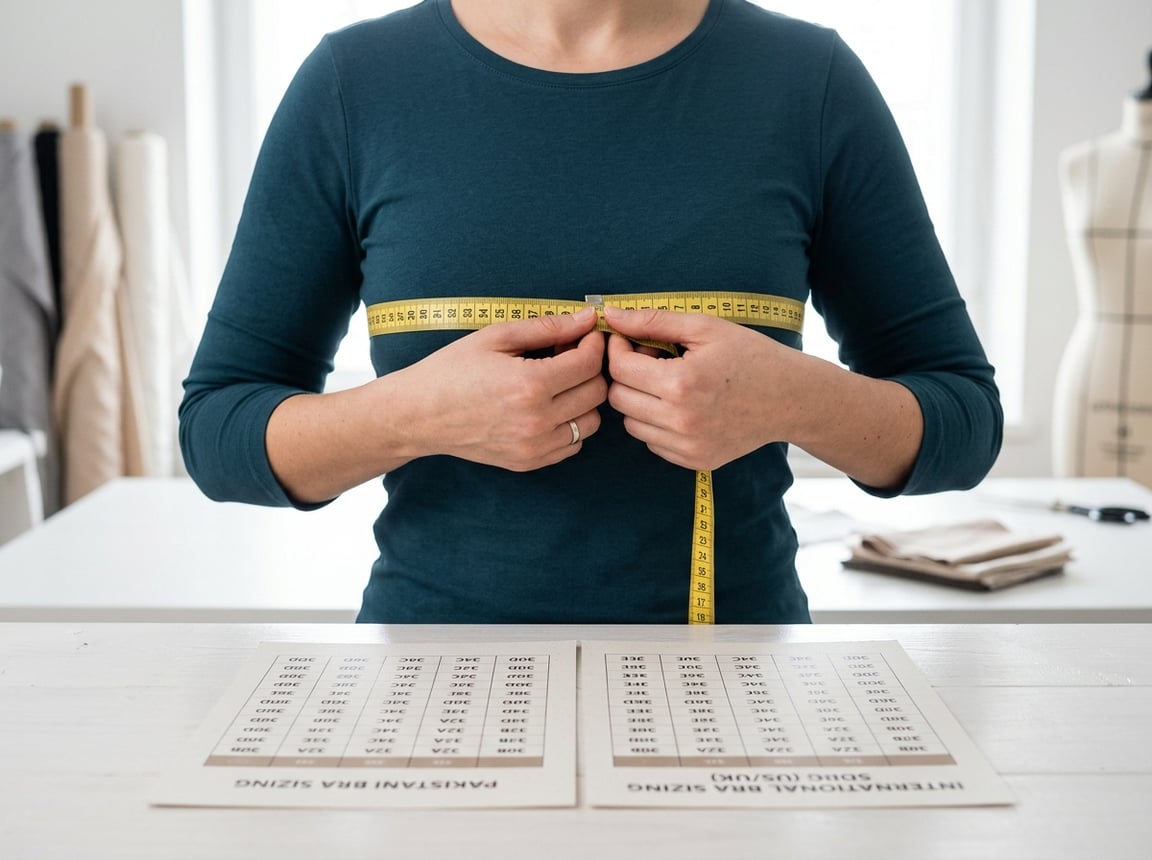
This article breaks down how Pakistani sizing works, the main international systems, handy conversion charts, and fitting tips to avoid classic mistakes. You’ll get clear measurement steps and conversion rules, plus some buying tips so you can order with a little more confidence, wherever you’re shopping.
How Bra Sizing Works in Pakistan
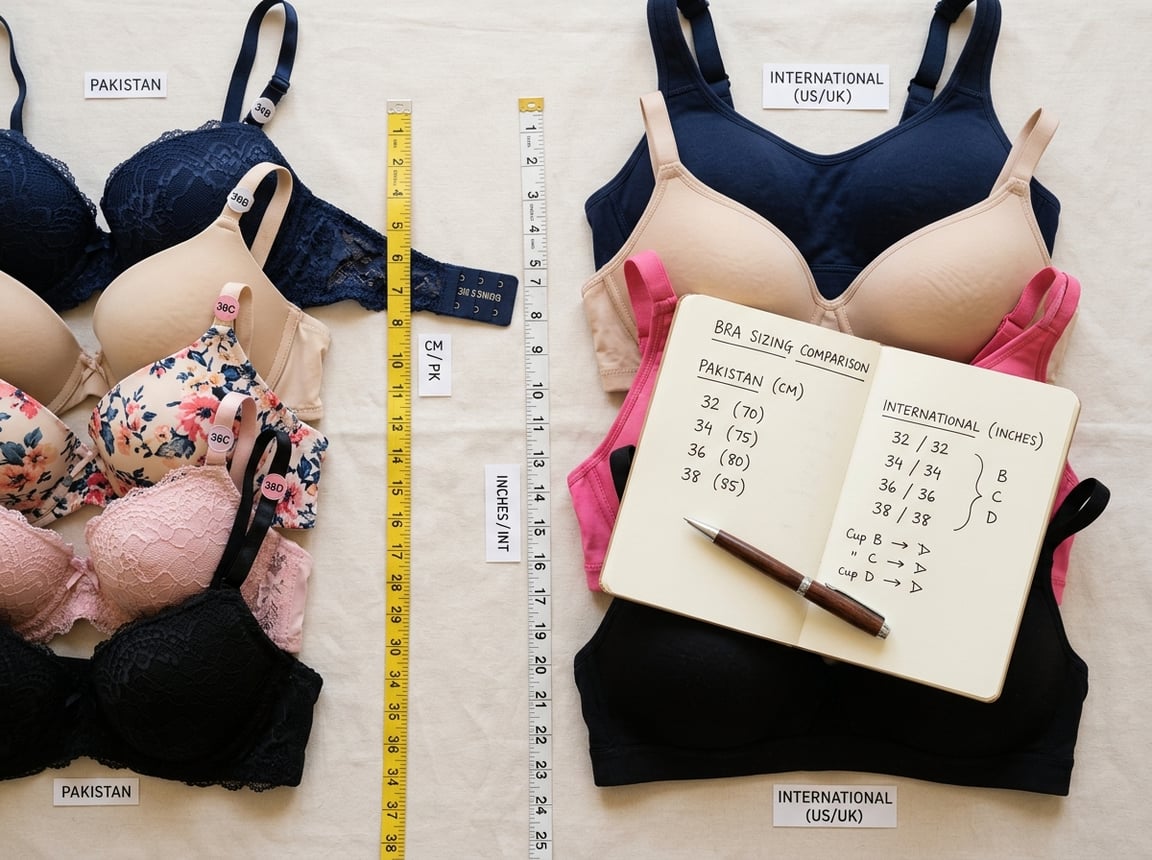
Pakistani sizing is a mashup of UK-style band numbers and local label quirks. Getting an accurate measurement is the fastest way to a comfy fit, honestly.
Band sizes are often international numbers, but cup labels can shift between brands. It’s not as straightforward as you’d hope.
Understanding Local Size Labels
Most Pakistani brands use band numbers like 32, 34, 36, just like UK or European sizing. But cup letters? They can run a bit small or large, depending on where they’re made.
You’ll spot sizes like "34B" or "36C" on tags, but the real fit can swing wildly between local and imported brands. Always check for actual measurements, band length in cm/inches, and cup volume notes because labels alone won’t save you.
When you’re shopping, always peek at the brand’s Pakistani bra size chart or conversion table. Match your underbust and bust numbers to what they list, or you’re just guessing.
Pakistani Bra Measurements Explained
Measure two things: your snug underbust and your full bust at the fullest point. Here’s how: first, wear a non-padded bra, then measure under your bust and round to the nearest whole number.
Next, measure across the fullest part of your bust. Convert cm to inches if you need to.
To get your cup size, subtract your band size from your bust measurement. Every inch (or ~2.5 cm) is usually one cup letter.
So, if your bust is 92 cm (36") and your underbust is 78 cm (31"), you’d get a band around 32/33 and a cup difference of about 5 cm (~2 in), which is roughly a B or C, depending on the chart. Always check the brand’s own chart for their rounding rules.
Common Sizing Challenges
Honestly, the biggest headache is the variation between manufacturers. Two bras labeled "34C" can feel totally different; band stretch and cup depth aren’t always the same.
Sometimes items are labeled in cm with no clear rounding, so sizes can drift. Weight changes, breastfeeding, or even age can shift your measurements, so re-measure every 6–12 months.
If you’re between sizes, try sister sizes: go up one band and down one cup, or the opposite, then see how the fit feels. Always look for the Pakistani bra size chart from the seller, and if you can, read reviews for fit tips.
International Bra Sizing Systems and Global Differences

Every country seems to have its own take on bands and cups. Pakistani sizing can shift compared to Western charts, and some country pairs mismatch more often than others.
Overview of Major International Bra Size Standards
Most places use a numeric band plus letter cup model (US/UK/EU/AU), but some regions, like Japan and parts of Europe, follow a metric system. The US and UK both use lettered cup sizes, but the UK continues with letters beyond D, using DD/E, FF, and so on, while the US prefers D, DD, DDD, which can make conversions tricky.
European sizing, on the other hand, uses bands in centimeters (e.g., 75, 80) rather than inches, as is common in the US and UK. To convert between UK/US and European band sizes, it's helpful to add or subtract around 15–20 cm after converting inches to centimeters. For example, a UK/US 34 band roughly translates to a European 75 band.
Japanese sizing can be different altogether, sometimes using S/M/L for ready-to-wear items, and numeric cups that don't correspond directly to the Western letter system. For these, it's essential to measure the bust and underbust in centimeters to get accurate sizing.
There is significant historical context around sizing standards, as detailed on resources like Wikipedia, which includes studies showing that more than 80% of people wear incorrectly fitted bras. This is often due to the confusion around different band and cup systems. Conversion tables and more detailed explanations are available for those needing precise measurements.
Quick checklist:
- Measure your underbust in cm.
- Measure your bust at its fullest point in cm.
- Calculate the difference between these measurements.
- Use that difference to map it to your target system’s cup progression.
By following these steps, you'll be able to navigate across these various sizing systems and achieve a better fit.
Differences Between Pakistani and International Sizing
Pakistani brands usually label bands in UK-style inches, but sometimes they use regional grading that can differ in sizing. The band might run smaller, or the cup larger, than what you'd typically find in UK/US charts. For example, a Pakistani "34B" might feel tighter than a UK 34B. In such cases, try sister sizes (like 36A or 32C) if the band feels off, but the cup seems right.
Pakistani bras are often tailored to regional body shapes and manufacturing standards, so cups may be designed to sit shallower or more projected. Always measure your underbust and bust, and compare the difference between these measurements, rather than relying solely on the label.
For a broader context, global aggregators such as WorldPopulationReview provide comparative breast-size data. However, treat these aggregated numbers cautiously, as they mix sales data, surveys, and self-reports. This can help situate Pakistani averages against international trends, but may not always offer an exact fit reference.
Notable Bra Sizing Differences Across Countries
Band increments: UK/US use even-inch bands (30, 32, 34), EU uses cm steps (70, 75, 80), and Japan has S/M/L. Cup letters and progressions are all over the place, so a “C” in one system might be a “D” somewhere else.
Sister sizing is your friend: up one band and down one cup (34C ↔ 36B) if the band’s tight but the cup fits. Brands like Victoria’s Secret, Wacoal, and Triumph all have their own quirks, so check their charts if you can.
Quick conversion tips:
- Convert underbust to cm for EU/FR sizes.
- Calculate the cup difference (bust minus underbust) to match cup volume across systems.
- Trust your measurements, not just the label, especially when buying online.
Bra Size Conversions: Key Charts and Guides
Conversion tables and clear steps make it way easier to jump between Pakistani and international sizes. Focus on your band measurement, cup-letter mapping, and size logic, especially when shopping across brands or countries.
Using Bra Size Conversion Charts
Look for charts that line up band sizes (28–46) and cup letters (AA–JJ) across systems. A typical chart will match the numeric band (UK/US) with the EU equivalent and show which cup letters match bust-to-band differences.
Example mini-chart:
- Band: 34 (UK/US) = 75 (EU)
- Cup: B (1"–2" difference) = B (EU/UK systems often match letters)
Find charts that list Pakistani sizing or local brands if you can. Some Pakistani brands follow UK sizing but might label bands in centimeters or use local scales. Always check the chart’s method; some use inches, some use centimeters.
Save a chart to your phone for quick checks when shopping online. Charts that show sister sizes are gold; they tell you which band-up/cup-down combos keep the same cup volume.
How to Compare Pakistani and International Bra Sizes
Measure your underbust and fullest bust accurately. Convert cm to inches if you need to (1 inch = 2.54 cm). Calculate cup size by subtracting band from bust and use the chart’s difference ranges (like 1" = A, 2" = B).
When comparing, check band number equivalence (Pakistan 75 ≈ EU 34), cup-letter consistency, and any notes from the manufacturer.
If a Pakistani brand uses local numbers, match your underbust to the nearest band on their chart. Then use an international conversion chart for the UK/US/EU size. Keep a note of which brands run small or large; it’s not always obvious.
Understanding Bra Size Conversions
Conversion boils down to two facts: your band measurement and the cup-volume relationship to that band. Cup letters are about volume relative to the band, so an A cup on a 32 band is smaller than an A cup on a 38. That’s where sister sizes come in; they keep the cup volume but change the band fit.
Common pitfalls? Assuming cup letters mean the same thing everywhere, and ignoring rounding when converting cm to inches or vice versa.
Here’s a quick process: (1) measure underbust and bust, (2) find the cup letter from the difference using the chart, (3) convert the band number to the target system, and (4) try sister sizes if the first fit isn’t right. Keep a checklist: band fit (should be level and snug), cup containment (no spillage or gaps), and strap comfort.
Finding Your Ideal Fit: Measurement and Fitting Tips
Measure your underbust and full bust carefully. Know how bands and cups relate, and use sister sizes to adjust for brand quirks. The three things to focus on: accurate measurements, correct size calculation, and a real-world fit check.
How to Measure for Bras Accurately
Use a soft tape while wearing a non-padded, well-fitting bra. Measure your underbust by wrapping the tape snugly around your ribcage under your breasts, exhale, and note the number in cm or inches.
Stand straight and measure around the fullest part of your bust, keeping the tape relaxed and parallel to the floor. Don’t squish yourself, just measure as you are.
If you can, take measurements in both cm and inches. If you have asymmetry, measure each side and use the bigger number for your cup size.
How to Find Your Correct Bra Size
Figure out your band size from your underbust. Use the exact measurement or round to the nearest whole number, depending on the brand’s chart. Subtract the band from your bust to get the cup difference.
Here’s a quick cup-difference table:
- 1" (2.5 cm) = A
- 2" (5 cm) = B
- 3" (7.5 cm) = C
- 4" (10 cm) = D
Adjust for regional labeling, UK/US, EU, and Pakistani systems, all label cups and bands a bit differently. Always check a conversion chart or calculator.
Remember sister sizes: if the band is too tight, go up a band and down a cup (34C → 36B) to keep the same cup volume but get a more comfortable fit.
Find Your Perfect Bra Fit
Put your bra on and fasten it on the loosest hook. The band should sit level and snug across your back, not riding up. You should be able to fit two fingers under the band, but not much more.
The center gore (the bit between cups) should lie flat. Cups should hold breast tissue without spillage, wrinkling, or overflow. Adjust straps so they support about 10–20% of the weight, with the band doing the real work.
Move around, lift your arms, bend, jump a bit. If it’s still uncomfortable, try a sister size smaller or a different cup shape. Styles like balconette, full-coverage, or plunge can all fit differently, even in the same size.
Smart Shopping: Tips for Buying International Bras
Start with super accurate measurements and a conversion chart for the brand or country you’re buying from. Know your current band and cup size in your usual system, and have a backup sister size in mind if your favorite isn’t in stock.
International Bra Shopping Tips from Pakistan
Grab a measuring tape and check your underbust (snug) and bust (fullest point) in centimeters. Do this while wearing a non-padded bra; trust me, it makes a difference.
Take those numbers and consult a reliable conversion table for the country you’re shopping from, UK, US, EU, AU, JP, or FR. That’s how you’ll get both the band and cup equivalents, but don’t rush it.
Always look at the seller’s size chart before you hit “add to cart.” Brand sizing can be all over the place, so don’t assume anything.
Look for band length in centimeters or inches, and check if they mention cup volume in milliliters or letters. If you see both UK and EU sizes, UK is usually easier for letter matches, while EU gives clearer numeric cup info.
If you’re torn between sizes, order two close ones, say, 34C and 32D, and send back the one that doesn’t work. Just remember to factor in shipping time and return costs, or you might regret it.
Avoiding Bra Sizing Mistakes When Shopping Abroad
Don’t fall for the trap that identical letters mean identical cups across different systems. A UK 34D isn’t the same as a US 34D in most brands, weirdly enough.
Convert both band and cup separately; never just trust the letter. It’s a hassle, but it saves you from disappointment.
Ignore vanity sizes on tags; if you can, measure the actual garment. Specs like underwire length, cup depth, and band elasticity tell you way more about fit than a random label.
Sister sizes are your friends. If a band feels too tight, try the next band size up and one cup size down (32DD → 34D). If the band rides up, go down a band and up a cup. It’s a bit of trial and error, honestly.
Decoding Size Labels When Shopping Bras Online
Scan product pages for a size-conversion widget or downloadable chart. Listings that show measurements in cm/in and the model’s stats are gold, making judging fit so much easier.
Read reviews that talk about whether the bra runs true to size, stretches out, or causes cup spillage. Prioritize recent reviews from buyers in Pakistan or nearby countries; they’ll know your struggle.
Use filters for your converted size, but double-check with the brand’s own chart. If you see multiple size tags (like EU/UK/US), cross-check with your measurements and use the most detailed info.
Still unsure? Don’t be shy, message customer support and ask for exact garment measurements. Things like band length unstretched, cup height, or underwire length can save you a headache.
Frequently Asked Questions on International Bra Sizing
How do I convert my Pakistani bra size to UK or US sizing?
First, measure your band (right under the bust) and your bust (fullest part) in centimeters or inches. Use a conversion chart to match band numbers and cup letters between systems. Pakistani sizing is often close to UK/US band numbers, but cup letters can shift.
If you already know your Pakistani band and cup, match the band number directly. Then, check the cup volume (bust minus band) against the target system’s increments. For instance, a 4–5 cm difference is usually an A cup, 6–7 cm a B, and so on. Map that to UK or US cup letters using a trusted chart.
What’s the easiest way to measure my band and bust at home?
Wear a non-padded bra that fits close to your body. Use a soft measuring tape, keep it parallel to the floor, and don’t hold your breath; just measure naturally.
Measure the band snugly under your bust, rounding to the nearest whole number. For the bust, measure at the fullest point, keeping the tape level but not digging in. It doesn’t have to be perfect, just consistent.
Why does the same bra size fit differently in different brands or countries?
Every manufacturer has its quirks, different standards, materials, and tolerances. A “34B” from one brand might have a totally different cup shape or band stretch than a “34B” from another.
On top of that, country systems define cup letters differently relative to bands. So, you can’t trust the label alone to guarantee the same fit.
How can I figure out my sister's sizes if my usual size isn’t available?
Sister sizes keep the cup volume pretty much the same, just shifting band and cup numbers. Go up one band and down one cup, or down one band and up one cup, to find a similar fit.
Example: If you wear 34C, your sister's sizes are 32D (tighter band) and 36B (looser band). Try both ways and see which feels better. You might be surprised.
What should I check in a size chart when shopping for bras internationally?
Don’t just look at the label, check band circumference and cup-volume info. The best charts show measurements in both centimeters and inches, and also list bust-minus-band differences for cup sizes.
Pay attention to the country sizing system, model measurements, and any fit notes (like if it runs small or large). Reviews mentioning sizing consistency across regions can be a lifesaver, too.
How to Decide Whether to Size Up or Down When Ordering From Overseas Stores
If reviews or the store mention that a style runs small in the band, it's usually a good idea to pick the next band size up. Fabric type matters too; very stretchy bands might be fine in your usual size, but if the material feels firm or doesn't give much, going up a band size is safer.
When it comes to cups, check photos or reviews for signs of spillage or compression. If you spot those, try sizing up. On the other hand, if people mention gaping, you might want to size down instead.
If you're unsure, don't just trust the label. Measurements and sister sizes are your friends here; lean on those rather than guessing.
Conclusion:
When shopping for bras internationally, it’s essential to understand the difference between Pakistani and international sizing systems. By using a bra size conversion chart and measuring accurately, you can ensure a better fit no matter where you shop.
For a seamless shopping experience, it’s recommended to double-check sizing guidelines on each brand’s website, as different manufacturers may have slight variations.